
Executive Summary
Master Data Management (MDM) is the discipline that enables organizations to maintain accurate, consistent, and trusted domain-specific master entities—customers, products, distributors, patients, and more—across all systems. It ensures enterprise operations and analytics are based on a single source of truth. Historically, MDM has been slow and resource-intensive, creating latency between data capture and actionable insights. Understanding MDM fundamentals—including master data, the lifecycle, and the distinction between transactional and master data—is essential before introducing AI-based acceleration.
I. Master Data Management within Enterprise Data Management
MDM sits within Enterprise Data Management (EDM), which also includes:
- Data governance
- Business intelligence and analytics
- Metadata management
- Data quality management
- Reference and master data management
- Data architecture and integration
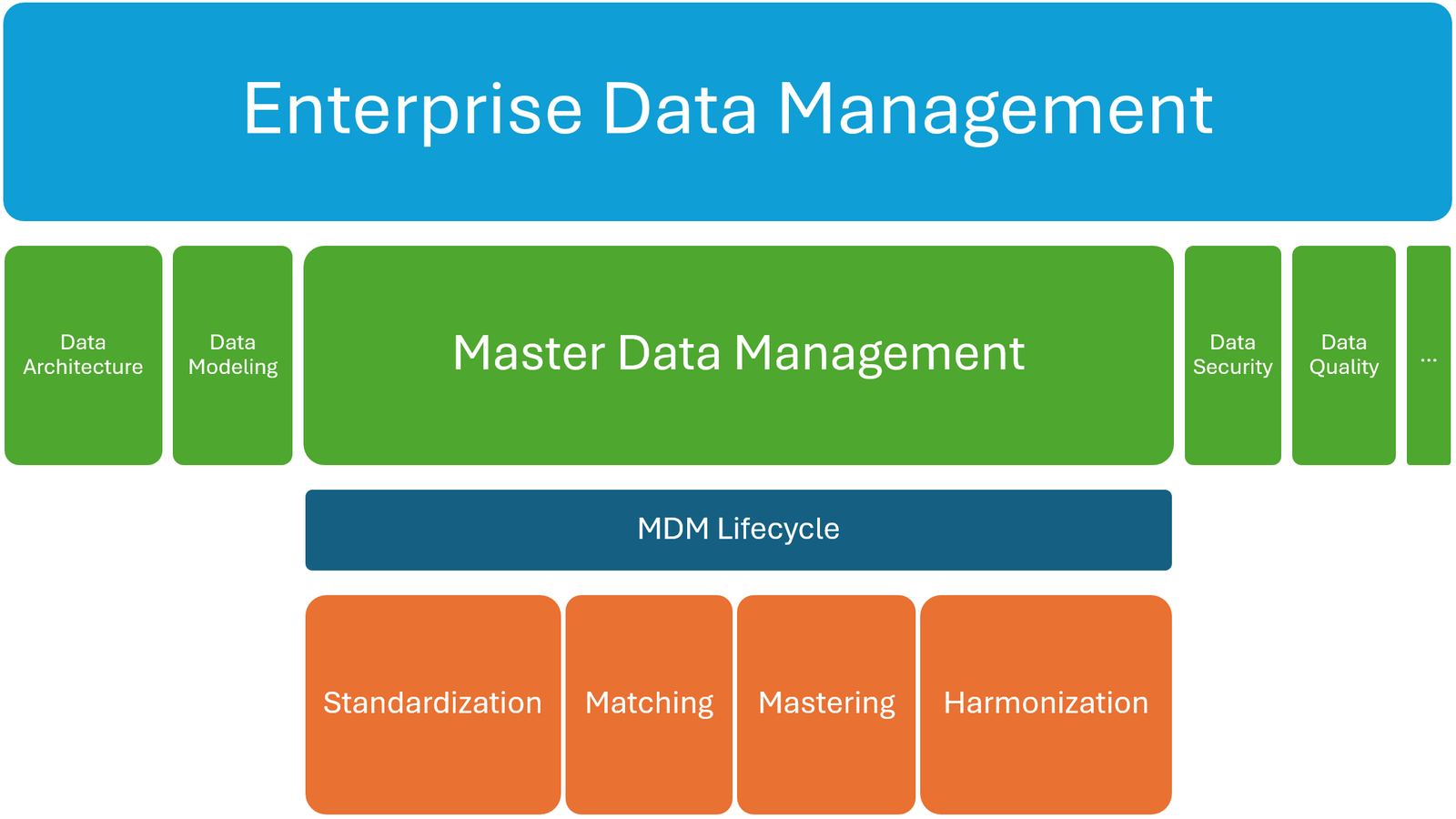
According to the DMBOK framework, EDM ensures that data assets are managed as strategic resources. Within EDM, MDM specifically focuses on master data, which differs from transactional or analytical data.
- Master Data: Domain-specific, slow-moving, shared across multiple systems. Examples: Product, Customer, Distributor, Patient entities.
- Transactional Data: Records of individual business events. Examples: sales orders, shipments, medical tests.
- Analytical Data: Summaries, aggregates, or derived metrics for reporting and decision support.
Notes:
- MDM serves both the operational and analytical needs of an enterprise. Therefore, consumers of MDM data include systems like ERP, CRM, BI / Data Warehouse.
- MDM is not a one-time project, but a continuous discipline. It includes the tools, people, and processes of Master Data Management.
Understanding Master vs. Transactional Data
Let’s look at a Semiconductor example of data where you can see both types of data.

An Example: Breaking Down the types of Semiconductor Data
- Transactional Data
Transaction_IDDateQuantityPrice
- Master Data
- Customer domain:
Customer_ID,Customer_Name - Location domain:
Ship_To_Address - Product domain:
Product_ID,Product_Name,Brand - Distributor domain:
Distributor_ID,Distributor_Name
- Customer domain:
Now let’s look at a Healthcare example of data where you can see both types of data.

Another Example: Breaking Down the types of Healthcare Data
- Transactional Data
Encounter_IDDateDiagnosis_CodeProcedure_Code
- Master Data
- Patient domain:
Patient_ID,Patient_Name,Patient_Address - Provider domain:
Provider_ID,Provider_Name,Specialty - Facility domain:
Facility_ID,Facility_Name
- Patient domain:
II. Defining Master Entities
Before MDM can operate, it’s critical to define master entities. This is where data modeling comes in:
- Each master entity represents a domain-specific object (e.g., Customer, Product, Distributor, Patient, Provider, Facility).
- Attributes for each entity are defined in a logical data model.
- MDM operates on these master entities, not raw transactions.
The transactional tables we introduced earlier served to illustrate differences between transactional and master data. From there, master entities are derived for use in MDM.
Let’s look at a Semiconductor example and a Healthcare example.
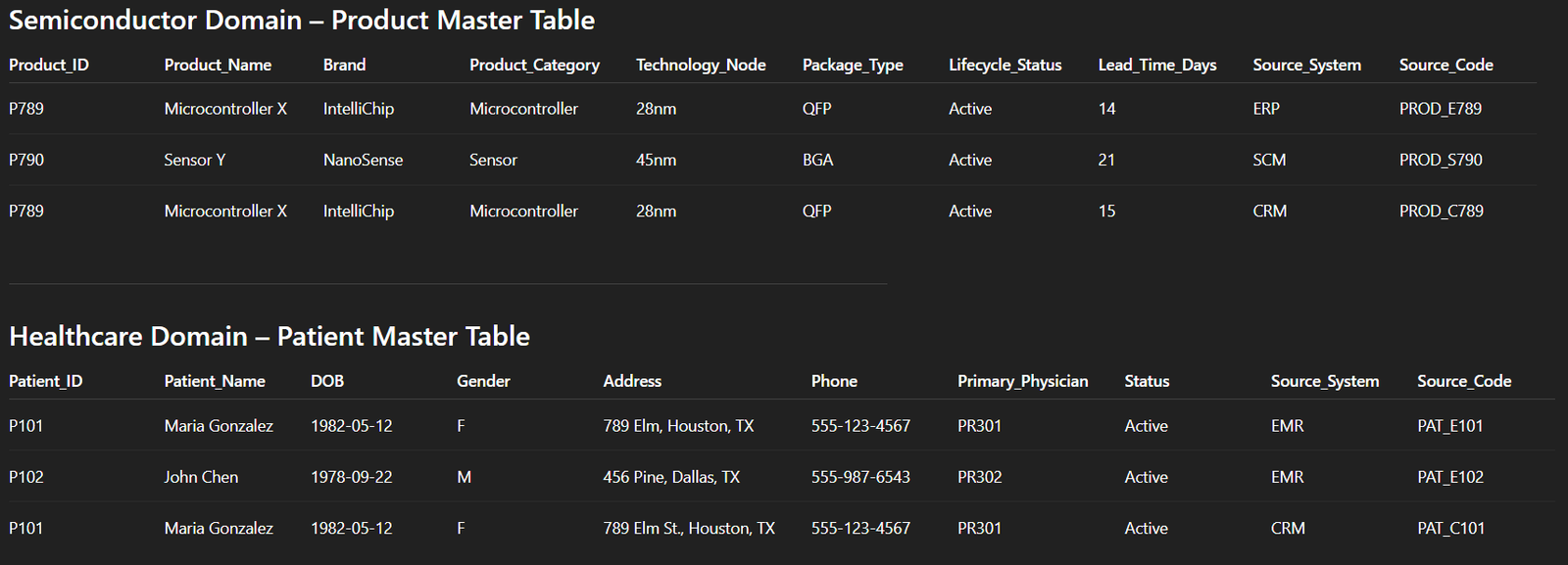
Key Points
- Each table is domain-specific, with only attributes relevant to the entity.
- These tables represent the master entities that MDM will operate on.
- Transactional tables are no longer used here; they were only for illustration of master vs. transactional data.
- The Source_System field shows which system the record originates from.
- The Source_Code provides the original identifier in that system.
- Multiple source records for the same entity demonstrate why matching, mastering, and harmonization are required.
- These tables now serve as input to the MDM lifecycle steps, showing how MDM resolves conflicts, merges duplicates, and produces golden records.
III. The MDM Lifecycle
The lifecycle of master data can be conceptualized in five key steps: Standardization → Matching → Mastering → Harmonization → Stewardship. Each step transforms data from diverse source systems into reliable, actionable master records.
Step 1: Standardization
- Normalize field values across systems. Examples:
- “123 Elm St.” → “123 Elm Street”
- “Microcontroller X” → “MICROCONTROLLER X”
Step 2: Matching
- Identify duplicates within and across systems.
- Example: Two
Product_ID = P789rows from ERP and CRM are grouped as representing the same product.
Step 3: Mastering (Survivorship)
- Select a golden record for each entity.
- Field-level rules determine which value survives: most recent update, preferred source system, highest rating, etc.
Step 4: Harmonization
- Propagate golden records to subscribing systems (ERP, CRM, analytics).
- Ensures downstream systems operate on the same trusted data.
Step 5: Stewardship
- Human-in-the-loop review for ambiguous records.
- Feedback corrects errors and improves future data quality.
Semiconductor – Product Master Lifecycle Example
Step 1: Standardization of Product fields
Goal: Ensure fields are consistent across sources (e.g., capitalization, abbreviations, numeric formats).
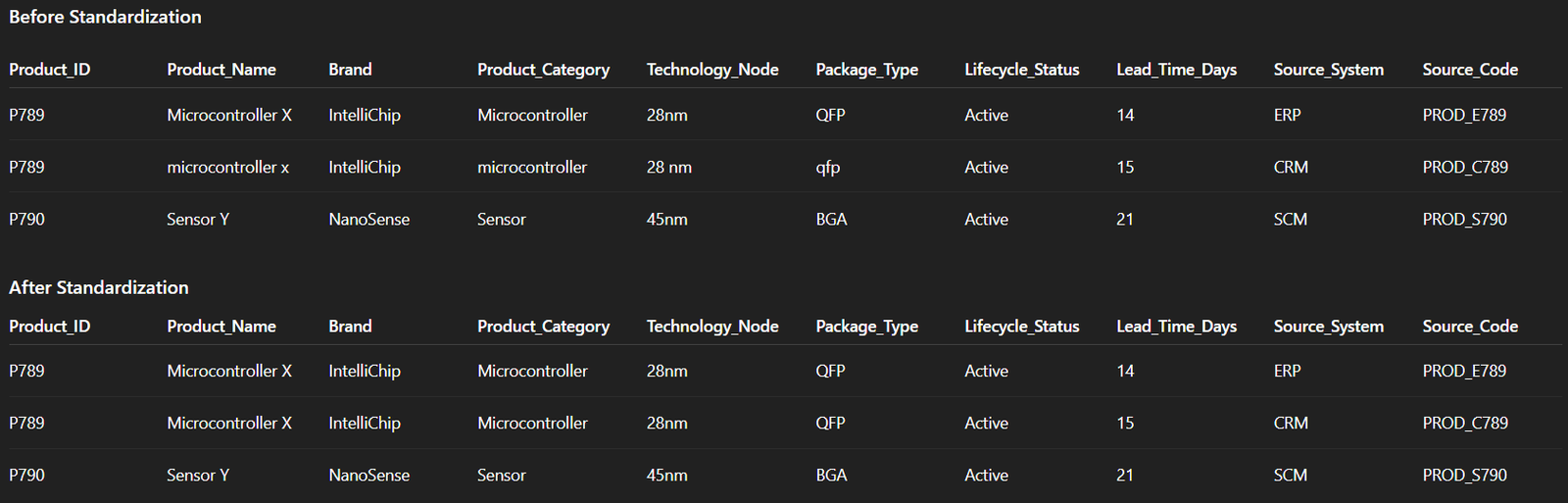
Actions Taken:
- Product names capitalized consistently.
- Technology_Node standardized (
28 nm→28nm). - Package_Type capitalization normalized.
Step 2: Matching of Semiconductor Products
Goal: Identify duplicates across source systems for the same entity.
Matching Table

Notes:
- P789 from ERP and CRM are duplicates, grouped together.
- P790 has no duplicate across sources.
- Match_Score uses fuzzy logic (name + brand + technology node).
Step 3: Mastering Semiconductor Products (Golden Record Creation)
Goal: Select the best value per field using survivorship rules.
Survivorship Rules Example – Product Master
| Field | Rule Example |
|---|---|
| Product_Name | Most frequent / ERP preferred |
| Brand | Consistent across sources |
| Technology_Node | ERP preferred if minor differences |
| Package_Type | Most frequently used format |
| Lifecycle_Status | Latest update from ERP |
| Lead_Time_Days | Minimum (fastest delivery) or validated source |
| Product_Category | ERP preferred |
| Source_Code | Retain all as historical references |
Golden Record Table

Step 4: Harmonization of Semiconductor Products
Goal: Make the golden records available to subscribing systems (ERP, CRM, SCM, BI).
Harmonized Product Master Example

Notes:
- Subscribing systems consume clean, standardized, and validated data.
- Historical Source_System / Source_Code can still be retained for audit purposes.
Step 5: Stewardship of Semiconductor Products
Goal: Handle proposed matches below auto-merge threshold.
Stewardship Table – Example (Simulated low-confidence match)

Notes:
- Human review required for uncertain duplicates.
- Ensures quality before merging.
Healthcare – Patient Master Lifecycle Example
Step 1: Standardization of Patient fields
Goal: Normalize fields across sources (e.g., capitalization, address formatting, phone formats).
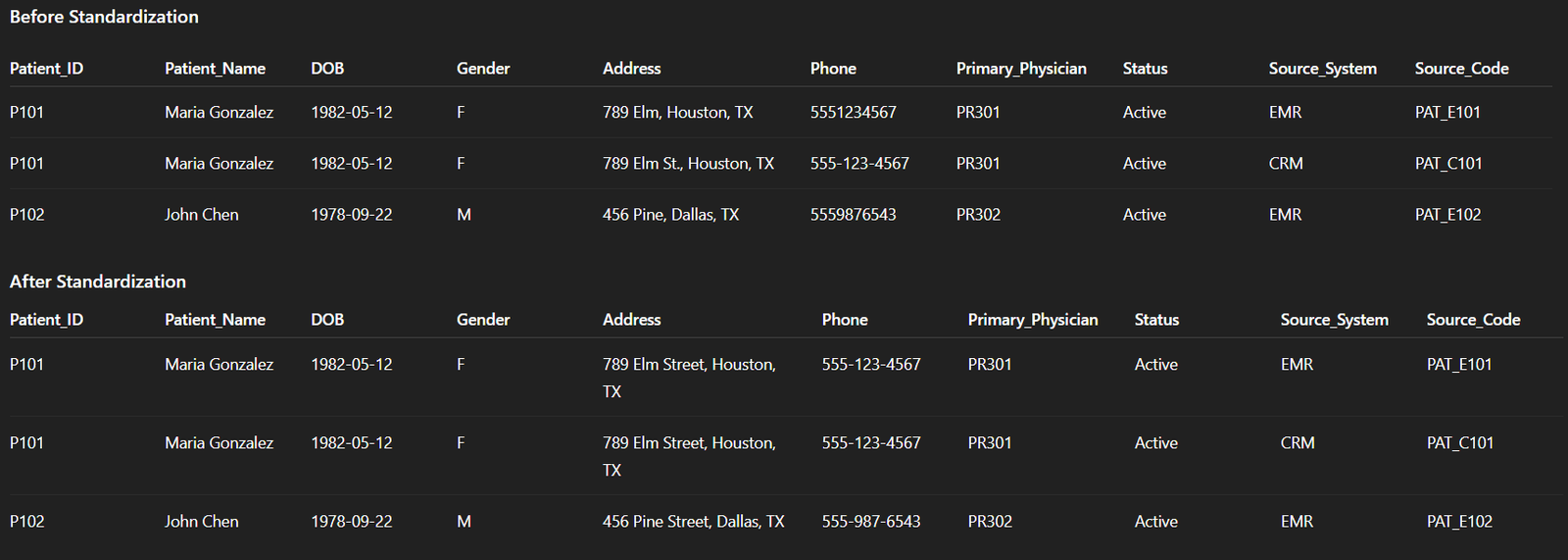
Actions Taken:
- Standardized addresses (“St.” → “Street”).
- Phone numbers formatted consistently with dashes.
- Names and other text fields normalized for capitalization.
Step 2: Matching Patients
Goal: Identify duplicates across source systems.
Matching Table – Patient Master

Notes:
- P101 records from EMR and CRM are matched into one group.
- P102 has no duplicate across systems.
- Match_Score can use name, DOB, address, phone for fuzzy matching.
Step 3: Mastering Patients (Golden Record Creation)
Goal: Create trusted patient records by applying survivorship rules.
Survivorship Rules – Patient Master
| Field | Rule Example |
|---|---|
| Patient_Name | Use most frequent / verified in EMR |
| DOB | Must be consistent; EMR preferred |
| Gender | Must be consistent |
| Address | Use most complete and validated address |
| Phone | Prefer EMR; normalize format |
| Primary_Physician | Latest assignment from EMR |
| Status | Latest update (Active/Inactive) |
| Source_Code | Retain all source codes for audit |
Golden Record Table – Patient Master

Step 4: Harmonization to Patient source systems
Goal: Share golden records with subscribing systems (EMR, CRM, BI, reporting).
Harmonized Patient Master

Notes:
- All downstream systems now consume validated, consistent, trusted patient data.
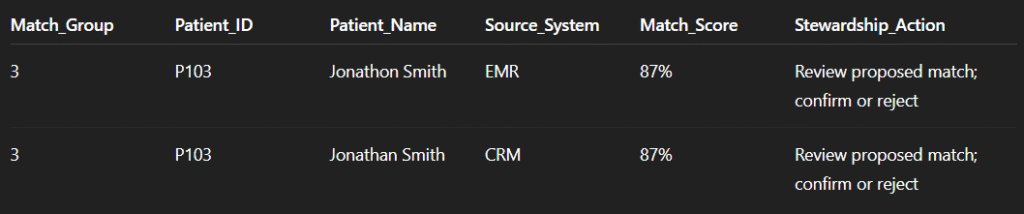
Step 5: Stewardship of Patient records
Goal: Handle proposed matches below auto-merge threshold.
Stewardship Table – Example
Notes:
- Human review ensures data quality and accuracy for low-confidence matches.
IV. Accelerating MDM with AI
Overview
Master Data Management traditionally faced challenges:
- Latency: MDM often took weeks or months to consolidate data from multiple sources.
- Manual interventions: Standardization, matching, and stewardship required human effort.
- Conflicting data: Choosing the “golden record” could be slow and error-prone.
AI can now:
- Automate standardization, matching, and mastering.
- Detect anomalies and enrich master data.
- Accelerate stewardship through intelligent suggestions.
- Provide real-time updates to subscribing systems.
AI Infusion Philosophy
AI does not replace MDM; it enhances and accelerates existing lifecycle steps. MDM engineers can select from a variety of AI/ML techniques depending on:
- Organizational needs
- Available infrastructure
- Data volume and complexity
The examples below are illustrative—other AI approaches could be employed equally effectively. We’ll illustrate how AI acts as an enabler in the lifecycle.
Step 1: AI-Powered Standardization
Concept:
Standardization often involves messy text data: inconsistent capitalization, abbreviations, or domain-specific jargon. AI, particularly Natural Language Processing (NLP), can learn patterns from historical data and normalize fields intelligently.
How NLP Can Be Employed:
- Tokenization: Split text into meaningful components (e.g., words, abbreviations).
- Normalization: Map common variants to canonical forms (“St.” → “Street”, “microcontroller x” → “Microcontroller X”).
- Context-Aware Correction: Use a language model to understand context (e.g., “28 nm” in tech node fields) to standardize consistently.
- Embedding Similarity: Compare tokens to known canonical forms using embeddings to correct unseen variations.
Python Example – Standardizing Product Names Using NLP
from transformers import pipeline

# Load pre-trained text classification / correction model
nlp_normalizer = pipeline("text-classification", model="your-domain-nlp-model")

def standardize_product_name(name):
    # NLP model predicts normalized/canonical form
    prediction = nlp_normalizer(name)
    # Assume model returns a 'label' field with the canonical name
    return prediction[0]['label']

# Example usage
product_names = ["microcontroller x", "Sensor Y"]
standardized_names = [standardize_product_name(name) for name in product_names]
standardized_names
Key Takeaway:
- AI standardization learns patterns and applies them consistently, removing the need for brittle deterministic rules.
- Only a single example is shown, but the same approach can be applied to other fields (tech node, addresses, phone numbers).
Step 2: AI-Powered Matching
Concept:
Matching across multiple systems is complex:
- Duplicate records are not identical.
- Traditional deterministic logic struggles with variations in spelling, missing data, or cross-system differences.
AI Agent Approach:
An AI agent can act as a “knowledge worker”:
- Ingest data from multiple source systems.
- Use NLP embeddings to represent text fields (e.g., product names, addresses, patient names) as numeric vectors.
- Store these vectors in a vector database for efficient retrieval and similarity comparison.
- Calculate probabilistic match scores between entities.
- Rank potential duplicates and propose match groups.
Vector Databases & Embeddings:
- Embeddings: Convert unstructured text into high-dimensional vectors where similar entities are close in space.
- Vector Database: Efficiently stores these embeddings and allows nearest-neighbor searches to find similar records.
- Probabilistic Matching: Match score = similarity between vectors; multiple features (name, address, DOB) can be combined using ML models to determine likelihood of duplicate.
Example Workflow (Conceptual):
- AI agent retrieves all product names from ERP, CRM, SCM.
- Embedding model converts names to vectors.
- Vector DB finds nearest neighbors for each product.
- Match probability is computed from similarity scores.
- Records with score > threshold are automatically grouped; others are flagged for stewardship.
Key Takeaways for Matching:
- AI agents are autonomous workers that orchestrate multiple tools: embeddings, vector databases, ML models.
- This approach reduces human review, increases accuracy, and handles large-scale datasets efficiently.
- Probabilistic match scores provide confidence levels instead of simple yes/no decisions.
Step 3: AI-Enhanced Survivorship in Mastering
Traditional Deterministic Survivorship
- Typically, each field has a rule like:
- CRM wins (source preference)
- Most recent update wins
- Highest price wins (for product data)
- Rules are applied sequentially to choose the golden record value.
AI-Infused Survivorship Concept
- Train a model to classify which record for a given field is likely the “best” value.
- Model input: record attributes, source, timestamp, historical accuracy, etc.
- Model output: probability that this record is the correct value for the field.
- Perform inference on the current dataset to generate an AI_Best_Score for each candidate record.
- Integrate AI_Best_Score into survivorship rule:
If MAX(AI_Best_Score) >> SECOND_BEST(AI_Best_Score):
    select record with MAX(AI_Best_Score)
Else:
    fallback to deterministic rules: CRM wins → most recent → highest price
Benefits:
- Handles ambiguity when multiple records have similar scores.
- Learns patterns from historical data, improving over deterministic rules.
- Provides probabilistic confidence instead of hard-coded decisions.
Python Example – AI-Based Survivorship Inference
Assume:
df_candidatesis a dataframe of candidate records for one field of a master entity (e.g., Product Price).ai_modelis a trained model with apredict_probamethod that returns a probability of being the best value.
import pandas as pd

# Sample dataframe of candidate records
df_candidates = pd.DataFrame([
    {"Product_ID":"P100", "Source_System":"CRM", "Price":100, "Update_Date":"2025-08-01"},
    {"Product_ID":"P100", "Source_System":"ERP", "Price":105, "Update_Date":"2025-08-03"},
    {"Product_ID":"P100", "Source_System":"SCM", "Price":102, "Update_Date":"2025-08-02"}
])

# Assume ai_model is pre-trained
# For demonstration, we define a mock function for inference
def ai_inference(model, df):
    # Normally, you'd extract features and feed into model.predict_proba
    # Here, we simulate AI_Best_Score
    df['AI_Best_Score'] = [0.75, 0.85, 0.80]  # Example scores from model
    return df

# Apply AI inference
df_candidates = ai_inference(ai_model=None, df=df_candidates)

# Determine winner based on AI_Best_Score and fallback rules
max_score = df_candidates['AI_Best_Score'].max()
second_best = df_candidates['AI_Best_Score'].nlargest(2).iloc[1]

if max_score - second_best > 0.1:  # threshold for confidence
    selected_record = df_candidates.loc[df_candidates['AI_Best_Score'].idxmax()]
else:
    # Fallback deterministic rule
    selected_record = df_candidates.sort_values(
        by=['Source_System','Update_Date','Price'],
        ascending=[False, False, False]
    ).iloc[0]

print("Selected record for golden field:")
print(selected_record)
Explanation:
- AI model predicts AI_Best_Score for each candidate.
- If the top score is significantly better than the second-best, AI wins.
- Otherwise, fallback to traditional deterministic rules.
Outcome:
- AI integrates probabilistic reasoning with human-understandable fallback rules.
- Golden record selection becomes more accurate and data-driven.
This approach can be applied field by field, allowing partial AI-driven mastering where some attributes are fully AI-selected, while others still follow deterministic rules.
V. AI Agent Workflow for End-to-End MDM
Workflow Concept
An AI MDM Agent acts like an autonomous data steward, performing the following tasks:
- Ingest Data: Collect records from multiple source systems (ERP, CRM, SCM, EMR, etc.)
- Standardize Fields: Normalize names, addresses, product descriptions, etc., using NLP and rule-based logic.
- Match Records: Identify duplicates across sources using embeddings, vector databases, and probabilistic scoring.
- Master Records (Golden Records): Apply AI-enhanced survivorship to select the best value per field.
- Harmonize Data: Push golden records to downstream systems in real time, applying anomaly detection.
- Stewardship: Flag low-confidence matches for human review and learn from decisions to improve future AI predictions.
Conceptual Diagram (Text Representation)
                 +----------------+
                 | Source Systems |
                 | ERP, CRM, SCM  |
                 +--------+-------+
                          |
                          v
                +-------------------+
                | AI Ingestion Agent|
                +-------------------+
                          |
                          v
                +-------------------+
                | Standardization   |
                | (NLP, regex, AI) |
                +-------------------+
                          |
                          v
                +-------------------+
                | Matching Agent    |
                | (Embeddings + VB)|
                +-------------------+
                          |
                          v
                +-------------------+
                | Mastering Agent   |
                | (AI Survivorship) |
                +-------------------+
                          |
                          v
                +-------------------+
                | Harmonization     |
                | Real-time updates |
                +-------------------+
                          |
                          v
                +-------------------+
                | Stewardship Agent |
                | Human-in-loop     |
                +-------------------+
VB = Vector Database
Python Pseudocode – Orchestrating the AI MDM Agent
What you see below are AI-infused definitions for each step in our MDM lifecycle. They can then be called together in the right order.
import pandas as pd

class AIAgentMDM:
    def __init__(self, models, vector_db):
        self.models = models
        self.vector_db = vector_db

    def ingest_data(self, sources):
        # Merge multiple source system tables
        df_all = pd.concat(sources, ignore_index=True)
        return df_all

    def standardize(self, df, field):
        # Apply NLP-based standardization model
        df[field] = df[field].apply(lambda x: self.models['standardizer'].predict(x))
        return df

    def match_records(self, df, fields):
        # Convert text fields to embeddings
        df['embedding'] = df[fields].apply(lambda x: self.models['embedding'].transform(x), axis=1)
        # Use vector DB to find duplicates
        df['match_group'] = self.vector_db.probabilistic_match(df['embedding'])
        return df

    def master_records(self, df):
        # Compute AI_Best_Score for each candidate record
        df['AI_Best_Score'] = df.apply(lambda row: self.models['survivorship'].predict_proba(row), axis=1)
        # Apply AI + deterministic fallback to select golden record
        golden_records = self.apply_survivorship(df)
        return golden_records

    def harmonize(self, golden_records, subscribers):
        # Push updated records to subscribing systems
        for system in subscribers:
            system.update(golden_records)
        return True

    def stewardship(self, df):
        # Flag low-confidence matches for human review
        review_set = df[(df['match_score'] > 0.7) & (df['match_score'] < 0.9)]
        # Human reviews and feeds decisions back to AI
        self.models['survivorship'].update(review_set)
        return review_set

    def run_lifecycle(self, sources, subscribers, standard_fields, match_fields):
        df = self.ingest_data(sources)
        for field in standard_fields:
            df = self.standardize(df, field)
        df = self.match_records(df, match_fields)
        golden_records = self.master_records(df)
        self.harmonize(golden_records, subscribers)
        review_set = self.stewardship(df)
        return golden_records, review_set

# Example usage:
# ai_agent = AIAgentMDM(models=my_models, vector_db=my_vector_db)
# golden, review = ai_agent.run_lifecycle(source_tables, downstream_systems,
#                                        standard_fields=['Product_Name', 'Address'],
#                                        match_fields=['Product_Name', 'Product_Description'])
Key Features Demonstrated
- Ingestion: Collects data from multiple source systems.
- Standardization: AI normalizes names, addresses, and other text fields.
- Matching: Probabilistic matching using embeddings and vector DBs.
- Mastering: AI-enhanced survivorship selects the best value per field.
- Harmonization: Automatic propagation to downstream systems.
- Stewardship: Human-in-loop review for low-confidence cases, feeding learning back into AI.
This agent workflow shows how we can orchestrate the entire MDM lifecycle, accelerating each step while improving accuracy and maintaining human oversight where needed.
How an AI Agent can Accelerate the MDM Lifecycle
Traditional MDM relies heavily on deterministic rules—hard-coded logic specifying which source wins, how fields are standardized, or how duplicates are matched. While effective, these rules are static, slow to update, and often brittle, missing edge cases or patterns that were not anticipated by humans. AI and machine learning accelerate MDM by inferring outcomes from historical patterns and current data, producing results much faster and at scale. For example, AI can detect subtle inconsistencies in product names or patient addresses that deterministic rules may overlook, propose probabilistic matches, and assign confidence scores that allow rapid decision-making. Over time, AI models auto-learn from new data and stewardship feedback, continuously improving the accuracy and coverage of MDM decisions. These inferred outcomes remain validatable: first through rigorous model evaluation, and second through sampling and human-in-the-loop stewardship, ensuring trust in automated processes while reducing manual effort.
Even More Value From Agentic AI in MDM
Beyond individual models, agentic AI introduces a new layer of acceleration and flexibility. An AI agent can understand human language prompts and orchestrate multiple tools at its disposal. For instance, a single prompt such as:
“Standardize the Customer fields. Perform survivorship utilizing the AI_Best_Score tool.”
triggers the agent to:
- Use an LLM to interpret the prompt and identify relevant fields.
- Sequentially feed each field into the appropriate standardization or matching tool.
- Collect and interpret the tool outputs, integrate them with other steps (like AI-enhanced survivorship), and pass the results to the next lifecycle step.
This creates a generalized MDM lifecycle agent that can be reused across entities and even domains—whether in semiconductor, healthcare, or finance—cutting development time, minimizing rule maintenance, and enabling rapid deployment of AI-powered MDM. The agent not only speeds up processing but also allows business users and MDM engineers to interact with the system naturally, leveraging LLMs as orchestrators rather than requiring deep technical intervention at every step.
VI. Conclusion
Master Data Management is foundational within Enterprise Data Management, ensuring organizations operate on a single source of truth across critical domains. MDM underpins consistent reporting, analytics, and operational decision-making.
AI and ML present opportunities to operate MDM faster, more accurately, and with less manual effort. Probabilistic scoring, NLP standardization, and agentic orchestration enhance the MDM lifecycle while remaining verifiable. MDM practitioners can leverage AI as a black-box capability, focusing on the business of MDM rather than engineering AI models.
Combining established MDM principles and AI augmentation allows enterprises to maintain high-quality master data with speed and reliability, supporting better decision-making and operational efficiency.